
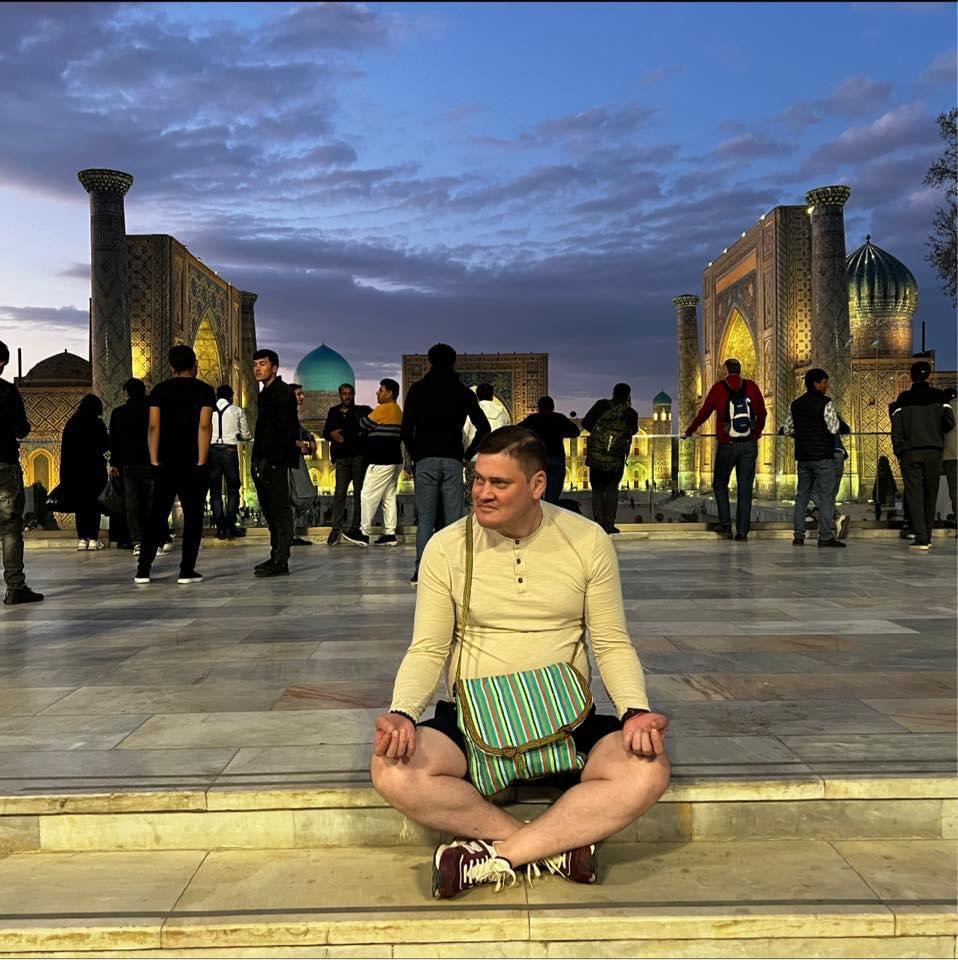
On many occasions, I have covered a record sent to me by, or even created by, one particular individual: Anvar Kalandarov. Anvar is a Day-Zero supporter or ARDENTLY Magazine and our core mission: making music from all over the world more accessible. He also works tirelessly to make music from his corner of the world more accessible to a wider audience via his record label, Maqom Soul Records. Recently, I had the chance to chat with him about his work, his mission, and reissuing archived or historic works. The following questions and answers come from our email threads and are edited for clarity only.
ARDENTLY Magazine: What, to you, defines an archival work?
Anvar Kalandarov: To be honest, I’m not even sure I really know what “archival work” means. I’m a collector first and foremost, and I simply love finding interesting things in the most unexpected places.
Usually, it starts with a song or an album that catches my attention for some reason. From there, it turns into a kind of investigation. I start trying to figure out when it was recorded, where it was recorded, who played on it, who wrote the music, and what was happening around it at the time. Then the process tends to take on a life of its own.
Sometimes you start digging into the story of a single track and end up discovering an entire musical and cultural world you barely knew existed. One name leads to another, then to another recording, another city, another studio, another story. You begin to see all these connections between people and places. Other times, you simply hit a dead end. There’s nowhere else to go, so you put the project aside and come back to it a year or two later, when some new piece of information suddenly appears.
I suppose that’s what archival work means to me. Not necessarily working in an archive in the academic sense, but constantly searching, following clues, and trying to piece together the story of a piece of music from whatever fragments are still out there.

AM: How do you determine which works get reissued and preserved?
AK: This one is a little easier: I always trust my own taste. That’s really the main criterion. I hear something I like, get curious about it, and start digging in that direction. It always turns into some kind of adventure.
But beyond simply liking the music, it’s important to me that a record represents something culturally interesting as well. Everything I’ve released, or plan to release, exists somewhere at the meeting point between the musical traditions of Central Asia and the Western sounds of the 1970s and 1980s. That intersection is what fascinates me most: hearing how musicians here absorbed jazz, rock, psychedelia, funk, electronic music or whatever else was reaching them, and then made something completely their own out of it.
Of course, ideally everything should be preserved. But I also know that I can’t do everything. My bigger goal with Maqom Soul is to bring the music of Central Asia to a much wider audience and make it more accessible. So when I choose a record to reissue, I’m not only asking whether it deserves to be preserved. I’m also asking whether it can tell people something about this region, its musicians and its musical history.
Of course, I have a plan for the label for the next year, but I’m the kind of person who is constantly looking for new music. You probably wouldn’t believe how quickly my collection grows sometimes, around 50 or 60 records a month. I listen to all of them, and whenever something catches my attention, I start looking for leads: who made it, where they are now, who might know them, and where the original recordings might be. So even with a release schedule in place, the search never really stops.
AM: How would you describe your taste in music?
AK: That’s probably the hardest question for me! My taste is a bit all over the place. On one side, there’s spiritual jazz from the 1960s, free jazz, and contemporary interpretations of spiritual jazz. I’m also into all kinds of post-bop and sometimes folk jazz, although I really don’t like the word “fusion”. I’m also a huge reggae fan. Lately I’ve been especially focused on the Nigerian reggae scene and the Wackies label.
Beyond that, I listen to a lot of music from Southeast Asia, the Muslim world, Africa and Central Asia. What I’m often looking for is music that sits somewhere between local traditions and Western influences, especially funk and reggae. That intersection is probably one of the things that interests me most as a listener and collector. And I also love Chinese hip-hop, just to make the whole picture even more confusing.

AM: What put you on the path of preserving and reissuing works like Yashlik and Oriental Suite?
AK: First of all, as I said earlier, I want to make this music accessible. Just go on Discogs and look at the price of an original copy of Oriental Suite. It can cost more than $200, and that really bothers me. Music like this shouldn’t be something you can only hear if you’re a serious collector with a lot of money to spend. I want to make the whole thing much simpler.
I’ve thought about this quite a lot, and at some point I realized that what I’m doing now isn’t actually that different from what we used to do when I was fifteen or sixteen. We would make cassette tapes for our friends, recording music we loved and wanted them to hear. Later we did the same with CD-Rs.
In a way, that’s still what I’m doing today. The scale is different, and now there’s research, licensing, restoration, mastering, manufacturing and all the rest of it involved, but the basic idea hasn’t really changed: I find music that I love, and I want to share it with other people.
AM: What was the piece that inspired the formation of Maqom Soul? What about it inspired you or pushed you to make your label?
AK: To be honest, it wasn’t really one particular record. It was more about the whole situation with Melodiya Records from Central Asia and the prices they’ve reached.
You want to hear some obscure Kazakh fusion record, you go on Discogs, see a copy selling for a few hundred dollars, and suddenly you don’t feel like discovering it anymore. That was really where the idea for Maqom Soul came from: I wanted to make this music accessible again.
Yashlik is probably the best example. When I first wanted to hear the album, I simply couldn’t find it anywhere online, no matter how hard I looked. There was one terrible-quality rip on YouTube, and at some point someone even offered to sell me a better digital transfer for $100.
That was the moment I thought, “Fuck this. I’ll release it myself and make the music available to everyone.”
AM: What makes these works so integral to the musical and cultural identities of Central Asian nations?
AK: That’s actually a difficult question for me to answer, because I don’t really think about this music in terms of national or cultural identity. For me, first of all, it’s simply very interesting music, and music that sounds completely different.
A lot of it was created outside the genre labels and clichés we use today. These musicians weren’t sitting there thinking, “Let’s make Central Asian psychedelic rock,” or “Let’s combine Eastern music with jazz.” They just wanted to play their own music, using whatever instruments, influences and ideas were available to them at the time.
And I think that’s exactly why these records still sound so fresh. The musicians weren’t trying to fit into a category or create something for a particular market. They were simply trying to make the music they wanted to hear, and they did it however they could. The result is something very specific to this place and time, but at the same time it doesn’t really sound like anything else.

AM: Why is it so important to preserve works like Yashlik and Oriental Suite?
AK: Most of this music was made in the 1970s and 1980s, which means that the people who actually heard it at the time, went to the concerts, bought the records and knew these musicians are now often in their sixties or older. And unfortunately, as that generation disappears, a lot of these names and stories will disappear with them.
You also have to remember that this music existed largely within the context of Soviet Central Asia. Its audience was mostly here in the region. There was no international recognition, no global music press writing about these bands, and in many cases very little documentation. Sometimes all that remains of a group today is one or two records, a couple of photographs and the memories of a handful of people. That’s it. And once those memories are gone, a huge part of the story goes with them.
So for me, preservation isn’t only about keeping the music itself alive. The record may survive somewhere in a collection, but without the names, photographs, stories and memories behind it, you lose the context that made that music exist in the first place. That’s why I feel there is a certain urgency to doing this work now, while some of those people and memories are still here.
AM: What can listeners learn from these kinds of releases?
AK: First of all, I hope these records can make people curious about Central Asia: about the region, its history and what life here was actually like. I think music has a very simple way of making distant places feel much closer. You put on a record from Uzbekistan or Kazakhstan from the 1970s and suddenly you realize that on the other side of the world there were young people doing exactly the same things young people were doing everywhere else. They were falling in love, dreaming about the future, starting bands, playing music, going out and dancing.
Maybe for someone, one of these records will be the first step towards discovering Uzbekistan or Central Asia more deeply. If that happens, then for me the release has already done something important.
I’m a patriot, and I would love to see a time when people talk about the music of Central Asia as a musical phenomenon in its own right, in the same way they now talk about Ethiopian jazz or Thai funk. There is an incredible amount of music here that the rest of the world still knows almost nothing about. I want to help change that.
AM: What are Maqom Soul’s goals going forward? What kinds of new-to-us releases can we expect?
AK: Oh, I’m definitely not going to reveal all my plans just yet!
What I can say is that I’ve recently started working on a few releases from Tajikistan. I also absolutely need to finish my Crimean Tatar reggae project, which has been waiting for me for a while.
And then in November there will be a collaboration with a very interesting label. We’re releasing an incredible recording from southern Uzbekistan that has never been released before. I don’t want to give away too much at this point, but I really hope it’s going to be a proper funk bomb.
There are a few other things in the works as well, but I think I’ll keep those to myself for now.

AM: Anything else you would like to add?
AK: Maybe just one thing. I don’t really like the idea of treating this music as something dead that needs to be rescued from the past. For me, it’s still very much alive. It just needs to be heard again.
Some of these records disappeared simply because of geography, history, limited pressings, or because nobody outside the region ever had a chance to hear them. That doesn’t make the music any less relevant today.
And I think that’s ultimately what Maqom Soul is about for me. I’m not trying to build a museum of Central Asian music. I just want to put these records back into circulation, tell the stories behind them when I can, and let people discover the music for themselves. If someone in London, Tokyo, São Paulo or anywhere else puts on one of these records today and feels the same excitement I felt when I first discovered it, then I think I’ve done my job.
You can follow along on Anvar Kalandarov’s journey in reissuing works from Central Asia through Maqom Soul Records’ pages on Bandcamp and Instagram. You can follow Anvar’s music as qorakitobchi on Soundcloud, Bandcamp, and Spotify.


Leave a Reply