
A conversation I’d love to have with the world revolves around how underappreciated music for movies is. Not the songs written for a “sound track” to go along with the film, filled to the brim with songs that were theoretically “inspired by” the film itself. No, I’m talking about film scores – the music written specifically for that film, made to influence the audience in how to feel, made to build and break tension, transport us to different worlds, and tell us a bit about the characters we are getting to know onscreen. Beyond storytelling elements, a film score has one other job: it must be able to stand on its own as a great composition. In other words, a great film score is something you can listen to as a standalone piece – you don’t need to be watching the film to appreciate it.
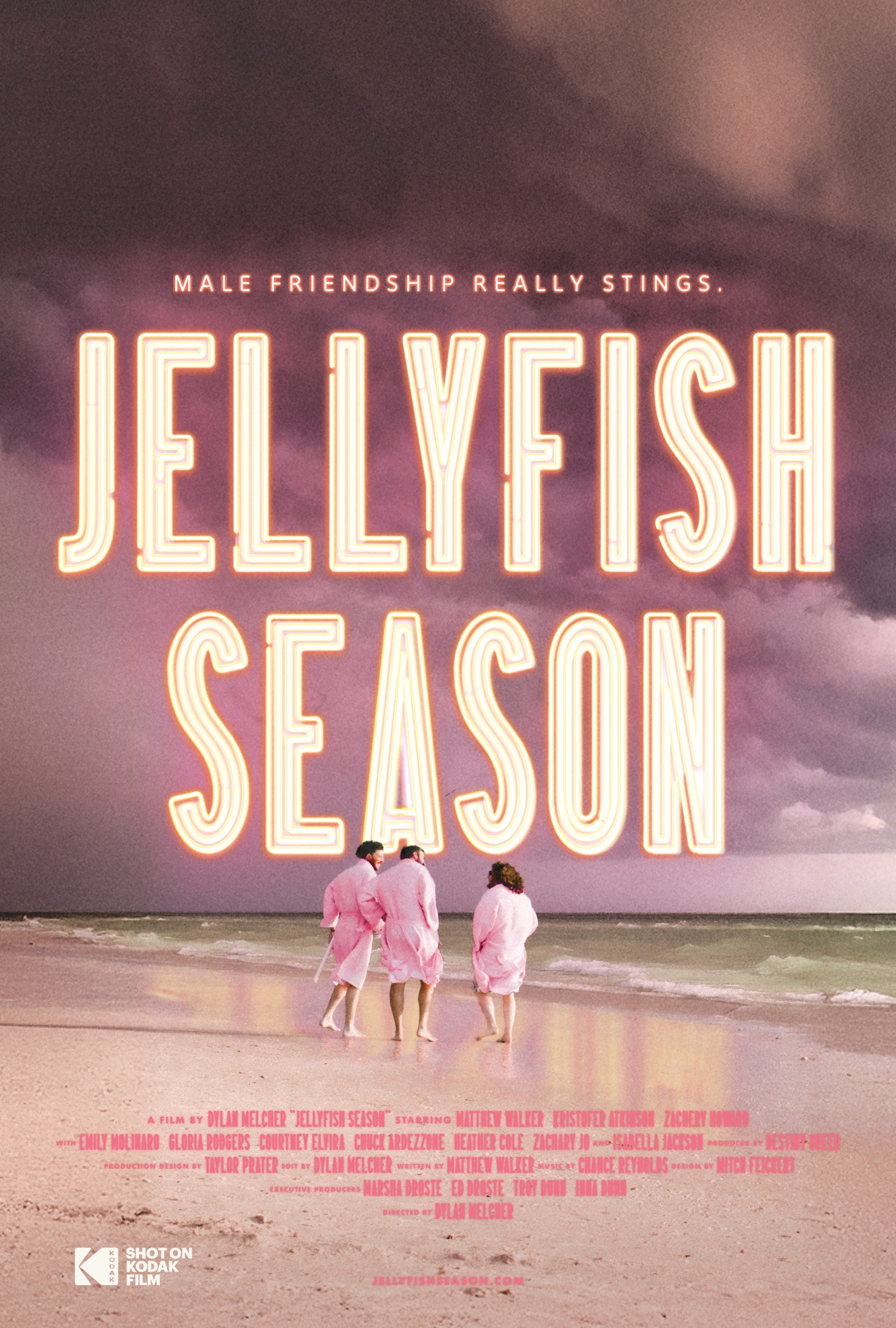
I’d like to start this conversation by exploring the film score of a brand-new feature film, Jellyfish Season. Directed by Dylan Melcher, Jellyfish Season is a film that centers around three best friends – Jay, Kay, and Zee – as they escape from their ordinary lives on a beach weekend that soon becomes anything but ordinary, taking a deep look into male friendships, midlife drift, and the extreme lengths that we may go to find meaning. The score was primarily composed by Chance Reynolds and performed by Reynolds, Eric Zabala, Alex Malkovich, and Cooper Madden. However, “Changed Being of Light” was written and composed by Will DeHaan, and “Chant” was performed by the three lead actors in the film: Matthew Walker, Kristofer Atkinson, and Zachery Howard.

You’d think that a beach weekend in Florida calls for something Beach Boys-esque, maybe even Country Pop or Latin Pop – something that feels so stereotypically Florida for those of us who haven’t got much of a connection to the state. However, this score took me by surprise. Instead of the Florida Georgia Line sound I was imagining, Jellyfish Season’s score is jazzy. It immediately reminds me of Jazz movements from the 1960s, like Lounge and Easy Listening, and of artists like Henry Mancini and John Barry – both classic film scorers who worked within the Jazz realm, including both Lounge and Easy Listening.

Immediately on the first listen, I am enthralled by “Zippo”. A crystalline vibraphone is the real star of this track, drenching this track in cool-toned chords. Truly, I am such a fan of a vibraphone moment. There’s something about mid-60s Lounge with a vibraphone that just really scratches an itch inside my brain in the most delicious way. “Zippo” really does just that – it’s upbeat, snappy, snazzy, pizzazzy, and just plain ol’, good jazz (think I got enough z’s in there?). Of course, the expressive drums, mysterious-sounding bass, and flashy saxophone are fantastic, building a cast of featured players that bring this song into a more lively mood and saving it from the otherwise inevitable fate of being relegated to “elevator music”, as so many pieces that feature the vibraphone are thought to be. Overall, “Zippo” is one of the stand-out tracks on this score, easily being my favorite.
To be honest, my fellow vibraphone lovers and I are definitely in for a delight throughout this score, with many of the songs featuring its dulcet tones. There are plenty of other amazing moments in the score besides my favorite star, the vibraphone. “Wrong Door”, for example, is a fun duet between two rather underappreciated instruments in our ensemble – the drums and the bass. Upbeat, spunky, dapper, and even a bit swaggery in its presentation, “Wrong Door” highlights the more “foundational” or “support” instruments in a traditional ensemble and showcases how lively and intricate they are, easily becoming head-turners on this track.
The penultimate track, the title track, “Jellyfish Season”, is another one of my favorites from this score. Leaning more into the Lounge sphere of influence, giving way to a chilled-out, softer side of the score. The heavy hitters here are the piano and drums, who carry this track forward, with the bass interpolating a cool complexity to the foundation of the track. The complex piano melodies feel akin to the kind of music I’d hope to find in a smoky cocktail lounge at 2AM, looking for a place to enjoy the ambience and a strong drink. It’s very contemplative, this track. As I’ve stated before, one thing that a film score must do is inform the audience how they are supposed to feel and subtly tell them what the characters are thinking and feeling. Perhaps “Jellyfish Season” hints that the film’s characters – Jay, Kay, and Zee – having survived their less-than-normal beach trip, are processing the lessons learned along the way?
Overall, I do think that the film score for Jellyfish Season has accomplished what a film score is meant to do: tell us how the characters are feeling, create and resolve tension, bring us into the film’s universe, and be a fantastic stand-alone piece of art. I know I would for sure love to see how this score plays out with the film itself. I’m hoping to find a screening here in the Bay Area, and if you want to see Jellyfish Season too, you can find a showing near you on either their Instagram or their website.
If you’d like to support the score of Jellyfish Season, you can listen to it on Bandcamp and you can soon purchase a copy of it on vinyl!



Leave a Reply