
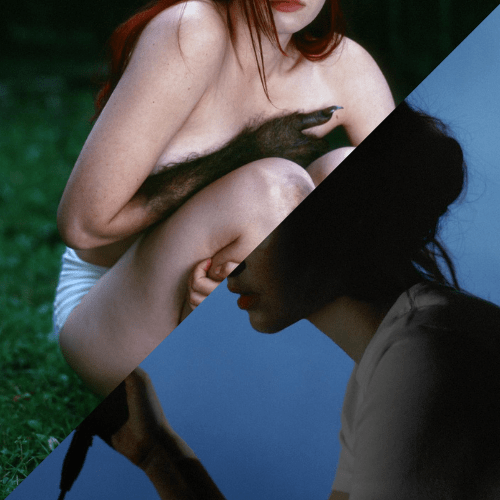
Despite its relative geographic position to the United Kingdom, rarely, if ever, does the average music listener concern themselves with music from France. The language barrier is apparently enough to separate it musically from the other “western” nations it’s otherwise closely associated with. This isn’t a unique thing to people whose first language is French – the same could be said for musicians who prefer to use their native tongue the world over. However, with few exceptions, it seems that native French speakers are unwilling to sing in English for a wider audience, unlike many of their European neighbors. This is understandable – I don’t necessarily expect anyone to feel comfortable making music in a language foreign to them – though it means that this trend is not likely to stop any time soon.
If French people in France have trouble obtaining an outside audience, then one could imagine how it must be for French speakers in a majority English-speaking country. Undeterred by the daunting task of staying afloat with a gradually waning audience, the Québécois in Canada still set sail from the Gulf of St. Lawrence to compete with other vessels in an ocean of music clambering to find listenership. Today, I will do my best to make others aware of a new ship lost at sea, so that it may not get swallowed under the great waves of obscurity. That captain of this boat is Lou-Adriane Cassidy and her two new records are Journal d’un loup-garou and Triste animal.
Cassidy released two albums in 2025, and one might expect that after such a short turnaround that Cassidy would have little time to develop a distinct sonic direction from one album to the next. Fortunately, for both the sleep-deprived writer and for the sleep-deprived reader, she did make time for such progression. So, what do the two albums sound like? I’m so glad you asked, my little pine needles – let me tell you!

Journal d’un loup-garou is interesting because its sound is definitely palpable, but not necessarily easy to define. The album is quite the medley of different influences from across the spectrum of electronic and dance music styles, yet I would hesitate to call it as such. It borrows so much from just about anything that’s ever had a programed drum machine loop and synthesizer and packs it as tightly as possible into these cute, little indie-pop ballads. Every song is just filled to the brim with all these effects and samples and whatnot – I feel like it starts to not only become a real distraction to the songs that Cassidy pens, but also, in certain moments, gives the album a sort of sonic identity crisis.
From reading my reviews and listening to what I cover, I realize that it might seem to our readers that I have an aversion to electronic music. However, none of what I have to say should be taken as an assessment of electronic production as a whole, but just as how this record uses it.
I guess a disclaimer like that really lays my cards on the table, as it were. In the album’s defense, there are several moments were the production is not only tasteful, but also does right by the song and actually enhances the listening experience. The introductory track, “Dis-moi dis-moi dis-moi” is great example of this. I absolutely adore the early disco vibes the song radiates. The song is laden with ornate and regal strings that are typical of early disco hits like “The Hustle“. The strings combine with the super bouncy bass line and energetic drum to really give the song an addictive, rhythmic punch.
The title track is also one of the better songs where the eclectic and eccentric combination of sounds feels like it serves the song rather than takes away from it. I love the ascending lines from the Taishōgoto, a 20th century Japanese keyed harp. It juxtaposed the lead marimba, triumphant synth stabs and slightly ominous drone to make for a track that comes across as psychedelic in its elaborate approach, yet, it all seems to come together to make an energetic and approachable song. The same cannot be said for much of the of rest of the record.
As much as I can appreciate the reference points a lot of these songs take from, it’s hard to be excited when it’s paired with Cassidy’s least interesting songs. “Prière quotidienne” sounds like it takes from synthwave with it’s reverb-y and throbbing synth lead, and the squelching synth bass and programmed trap drums feels reminiscent of a lot of acid house like that of 808 state, specifically the album 90, which I like, but the song itself feels so nondescript. While much of the material isn’t anything to write home about, I don’t feel like it’s actively pushing me away like the song “Je pars un vacanes” does.
Not only do I find the chord progression just to be bland and sour to my ears, the song has a real plodding, drawn-out pace with the most tiresome chorus; the moments where the instrumental cuts out entirely whilst Cassidy is still singing fail to come across as novel and only serve to annoy. I do like the sort-of whimsical aesthetic the song is couched in, the flutes and wailing synths are a fun addition with Cassidy’s background choral vocals, but they alone cannot save the song.
I don’t really like being so negative; this is not a bad album nor is it without any good songs or enjoyable moments. I don’t write these things to tell Cassidy she’s a terrible artist and that I find her work totally contemptible but rather because I know she can do so much better. I know she is able to write an assortment of catchy, succinct and comprehensive songs because she did so on the following record.
By stark contrast, Triste animal is a much more reserved listen and remains all the more colorful and effervescent for it. Foregoing most electronic elements, the album instead opts for a stripped-back sound built around jazz chords and predominantly acoustic instrumentation. I can’t put into words just how much this change in sound allows for Cassidy’s songwriting to really shine. No one musical motif or effect serves to distract from the song, yet they sound just as lush and vibrant as the songs from Journal d’un loup-garou.
Triste animal wastes no time in making great use of the 26 minutes allotted to entice the listener. In that short span, it never feels like the album is the worse for not stretching the songs out – they’re all as long as they need to be. They’re all filled with infectious choruses and beautiful, yet brief musical passages. There’s just a certain immediacy so prevalent in these songs that I struggle to understand their absence in the previous album.

The prime example of this is the fourth song “Adieu”, which you might recognize if you read my summer Shae-List. It’s such a bittersweet tune that is heartbreakingly gorgeous – I love how the pre-chorus leads any unsuspecting listener to a total knockout, gut-punch of a chorus. The last go-around builds upon the chorus with added vocal layers, and the final line peters out into a soft, willowy goodbye. Regardless of a language barrier, the message is clear: it’s a heartfelt goodbye that you can hear in the song’s last few seconds. I get goosebumps every time I listen to this song – it might be an all-time favorite.
While nowhere near as much of a tear-jerker, “Jamais tout à fait” does emphasize the jazzier parts of the album rather nicely. The song is built around piano chords that wouldn’t feel out of place on a Coltrane or Thelonious Monk record. The instrumental also has some guitar strumming and percussion that feel reminiscent of Bossa Nova, a bit like “The Girl from Ipanema“. I love the almost whispered background vocals throughout the song that give a warm and cozy vibe in tandem with the pianos. Despite it’s feathery tone, it still remains as compelling and satisfying as ever.
On the opposite end of the spectrum, “Valse frustrée” is nowhere near as jazzy or as elaborate with its composition, yet remains just as gratifying as the rest of the album. Its relatively aggressive acoustic strumming and impassioned, almost strained, vocals from Cassidy really help to sell the track. Even without the jazzier elements, the record manages to maintain a comprehensible sonic identity – nowhere in the record is that ever compromised, no matter the variation in song.
If Cassidy’s music proves anything, it is that the world is filled with fantastic songwriters and musicians. They exist regardless of language, culture, or national borders. When people think of Canadian music, it’s typically from places around Vancouver or Toronto. Little consideration is given to the musical exports of the sizable French-speaking population, and even less is given to First Nations people living in Canada. Yet, they’re still out there – sailing on their little boat on whatever body of water is closest, just waiting to be discovered. Maybe it’s high time we take a little voyage ourselves and join them out there on the water.
If you would like to listen to either record, both albums are available for streaming on YouTube Music, Spotify, Apple Music and Amazon Music. If you would like to support Lou-Adriane Cassidy than you can purchase both albums on her Bandcamp.


 ARDENTLY
Leave a reply to Elizabeth Schurwan Cancel reply