
“…the world either has a happy or a tragic ending. I think it’ll have a happy ending, that is what’s modern.”
…said Charly García in December of 1983, as Argentina made the transition to democracy after 7 years of military dictatorship and 30,000 missing people. During this time, individuals that openly opposed the regime were forced to live in exile to avoid capture, torture, and eventual assassination. This was García’s case. While hidden in New York, he encountered the New Wave scene of the early 80s. Grief-stricken and inspired by these new sounds that were yet to reach Latin-America, he gave birth to his magnum opus: Clics Modernos.
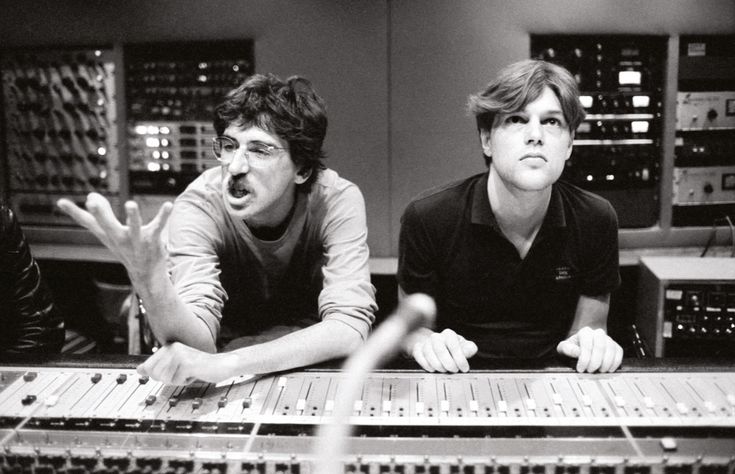
The first highlight of the album would be its opening track and hit single, “Nos Siguen Pegando Abajo”. The song opens with the synthetic sound of the Roland TR-808 Rhythm Composer, that directly opposes García’s previous work, characteristic for being mostly acoustic and melodic. An electric guitar and keyboard join to fabricate an artificial, robotic world. The beats are mechanical and relentless. Such sound was achieved by the one and only Joe Blaney. Handpicked by García after listening to his work in The Clash’s Combat Rock, he came in as producer and they both got to work at Jimi Hendrix’s Electric Ladyland Studios. Blaney’s mixing is sharp and dry. Through the entire record, he maintains a consistently polished sound that keeps every instrument in separate lanes. This allows him to choose when to highlight each sound separately and when to make them come together.
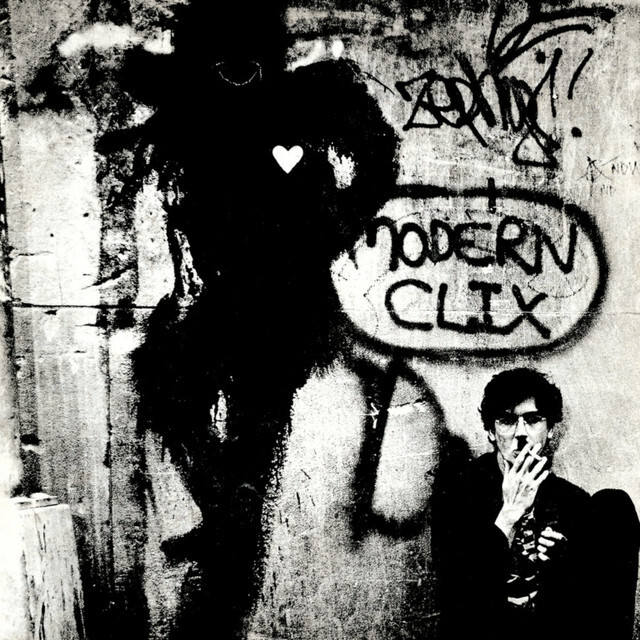
In this fabricated mechanical world García’s lyrics bring life, dominating the machine. He creates escalating tension through selective restraint against the instruments. This choice is meant to enhance the crude thematic of the song that, through the lyrics, directly addresses the government’s kidnapping and assassination of citizens deemed political enemies. The references would also be present in the album’s cover, where Charly García is sitting next to a silhouette meant to represent the victims.
Carrying on this intentional imagery, he constantly creates a juxtaposition between heavily political lyrics and innovative pop sounds. He even introduced the concept of sampling to the Latin-American audience in his second hit single “No Me Dejan Salir”. The track contains seven different samples from James Brown’s songs that accentuate the danceable pop rhythm it carries. The odd nature of this technique at the time of the album’s release caused licensing problems since lawyers didn’t know how to deal with something no one had ever done before in the region.
The second half of the album slows down, offering contrast. The tracks in this section are more introspective and melancholic. I’d like to bring special attention to “Los Dinosaurios”, a song with a powerful piano that possesses heavy classical influences. This grandiloquent atmosphere accompanies García in some of his softest, sweetest vocals, almost turning the song into a lullaby. The only other perceivable sound is a recurring woosh of air that makes the mood evolve from melancholic to haunting.
Such a raw interpretation is meant to bring attention to the heavy subject matter. Yes, Charly again protests the fascist regime, but this time from a place of hope. His now iconic verse:
“The friends from the neighborhood might disappear, but the dinosaurs will disappear too.”
…sends a message of resistance to the Argentinian people. García gets rid of the machine to appeal entirely to sentiment. This song feels like the odd one out of the album because of that very same aspect. He chooses when the machines work for him and when they don’t, metaphorically reclaiming the power of the people over the authoritarian state. The impact of the song was so big it is nowadays considered the unofficial anthem of Las Madres de Plaza de Mayo, a human rights organization made up of mothers who were looking for their missing children during the dictatorship.
Incidentally, Videla’s authoritarian regime was overthrown a month after the album’s release, this album becoming the soundtrack of Argentina’s liberation. Four decades after its release, this classic of Latin-American Rock is a historical record of a distant time that illustrates prevailing issues that are still relevant nowadays. Through this work, Charly García dominated the electronic world, and Argentina won against the machine.
If you’d like to stream the album or just check out more of Charly García’s work, Clics Modernos is now available on YouTube Music, Apple Music and Spotify.



 ARDENTLY
Leave a comment