
A while back, I had the opportunity to sit down with ratstallion – a Denver-based band that describes themselves as postgaze. Like with many artists I enjoy, I found them while scrolling through Instagram and came across an ad of theirs. I have really enjoyed their music and had a fantastic time getting to know them and their music better. I hope you enjoy ratstallion, too!
The original video interview with ratstallion was an hour-long conversation, and this transcription has been edited for clarity and length purposes.

ARDENTLY Magazine: Hi ratstallion! So great to finally meet y’all! Could you please introduce yourselves to the ARDENTLY audience?
Phoebe: I’m Phoebe – I do vocals and guitar. This is Max –
Max: Hi, yeah, I’m Max and I do guitar.
P: And this is Lenny.
Lenny: I’m Lenny. I do bass guitar.
AM: How was ratstallion formed?
P: That’s a good question. Max and I have been friends since college, and we’re in a couple other bands in Denver that have been kind of long-running. At this point, I think we’ve collectively both been in bands for like, the last 12 years in this town. I think we just kinda [were] like, “what if we started our own project?” and originally we wanted to start a surf rock band, so if you wanted to be really reductive, that’s how ratstallion was originally started. We quickly realized, “oh shit, we don’t make this kind of music”, and everything was just turning into shoegaze anyway, so we we’re like “maybe we just do what we do”. And Max and Lenny work together, and Max was like “hey, my coworker plays bass” and that’s how we got Lenny. And then we flex a drummer. We have a couple drummers that are like, on rotation just as recording, practices, and shows require.
AM: What inspired the name “ratstallion”?
P: Oh my god, okay, so it’s kinda funny. So it’s a World of Warcraft term, but I had no idea that was a thing until we started putting music out and we were like “who is this other ratstallion that we keep coming across”? How it was actually named was that me and my childhood friend actually made this term up for guys who are hot but not. Like at [a] glace you’re like “oh my god, yes” but then you’re like “wait a second” – like your Benedict Cumberbatchs, like Jeremy Allen White, you know what I mean?
M: The messy dudes.
P: Yeah, exactly.
AM: I love the visual of a ratstallion! You mentioned starting with surf rock, but everything was still coming out like shoegaze. I’m curious – what inspires your music?
P: That’s a great question. I think lyrically, it’s all over the place. Our song “Pit” is just a poem I wrote about fossils. Like, for some reason I was really upset about this La Brea Tar Pit documentary I was watching. I was like, “it’s so sad” and then wrote this poem about that. Like I said, it’s really all over the place, but there’s a deep thread of existentialism between the three of us, and that leaks through everything.
M: Instrumentally, I think, for me – though I am very curious about how y’all would answer it – a big inspiration is wanting to write with a lot of ambiguity. Like, I want to write a guitar part that might sound like it could be a synth part, you know? I want there to be a lot of tones flowing together. I think that a lot of our other bands have very stark, separated sounds and we wanted to experiment sonically.
L: I think I’d agree. All three of us have a lot of millennial existential dread, especially in terms of how it sonically comes together. The way that I write the bass parts for ratstallion is kind of like “how can I reductively write so that it doesn’t sound like the bass part really belong, but it still kind of belongs”.
M: Some of our songs come from Lenny writing the song backwards, and we realize that it sounds like a different song, so there’s a couple [songs] that are technically the same riff or the same chord progression, just [going] the other direction, you know? We like to experiment a lot.
L: Yeah, I like to riff off Phoebe.
P: I feel like I – how do I, in a theory sense, make sense of what and how I’m doing things, which is very much, like, not a sensible way. In my writing style, I’m just like “oh it sounds okay”.
AM: Sometimes the best things don’t make complete logical sense, especially in experimentation. But, if you could reduce, I suppose, ratstallion’s music into three descriptive words, which three words would you use?
P: I feel like I’m gonna circle back on “existential”, for sure. I think, maybe, “dense”? I think there’s a lot happening lyrically, musically, and interpersonally…All of us are kind of fucking nerds, so what I enjoy in our music is being able to listen to it and hear something different every time. Like in [our song] “Dust”, there’s this like weird harmony going on that you can hear both ways, but only if you focus on it. It’s really subtle and probably goes unnoticed. It’s one of those things where you only can hear it the way in the lens of your focus. What’s that called? It’s that kind of “Laurel-Yenny” thing, but it’s just with a different polytone, which is fun for me. What else…
M: I wanna say, like, “fun”. Mainly just because it’s really fun for me. Like, we’re all nearing 30 or are in our 30s and have careers, and if I could say to my 15-year-old self that I’d still be having a really fulfilling and rewarding and fun time making music, I feel like it would have ironed out a lot of issues I had back then, knowing that [this] was in my future.
P: Maybe another good word would be “somber”? Like, sonically –
M: Maybe “methodical”?
P: Ooh, yeah, “methodical” is a good one.
L: There might be people who call [our music] “fun”…maybe we should check in on those people who call it “fun”. I don’t know if I’d have a word to describe [our music] that Phoebe and Max haven’t already used. Maybe “grungey”? That’s a word, I guess.
AM: It sounds like y’all have been in each other’s social circles for quite a while. You said you’ve been friends for 12 years, Max and Phoebe?
M: Yeah –
P: No –
M: Maybe even longer –
P: Noo!
M: No?
P: It’s been like, maybe 7 years?
M: Yeah?
P: I would have been like, 13 – that’s not true.
M: We’re the leftovers of the college crowd that stuck around, right?
P: Yeah, I would have been like 19.
M: I’ve known Lenny [for a while]. We’re both therapists and I’ve known Lenny since he was an intern, which was right after I was done being an intern, so that was like, 5 or 6 years ago then.
L: 2018, I think. Like August or September 2018. And then Phoebe – we met last year, like July.
AM: So, July 2024 was kind of like the birth of ratstallion?
All: Yeah.
P: Yeah, I’m pretty sure. We’re a Cancer, I think.
M: Unless you count the proto, pre-Lenny days.
P: Yeah, like the surf rock days.
M: We were throwing shit at the wall, for sure. There’s a period of a year and a half –
P: We would communicate through voice memos, which was just like, so gross –
M: [We would] write songs by reading tarot, [we would] be like “what should happen next?” –
P: We were actually not even having band practices. What was happening was that we would just be like, hanging out and be like “oh, I guess we’ll write a riff”. Like, “we should actually show up and write something” but then it’d be like “whoops, guess we’ll order Thai food”.
M: Lenny showing up and his approach to writing really locked us all into producing material at the fastest rate of any project I’ve ever been in.
P: Yeah, Lenny was holding it down. [Max and I] are kind of like butterflies on a string, in terms of a creative project.
AM: I relate to butterflies on a string so much. Did y’all start playing together in July 2024? Was it just kind of a “okay, we’re making this a project”?
P: I think we just kinda dove right in. But our first song, “Dust”, was actually a pre-Lenny song that I wrote while dogsitting for my parents. We were like “oh, we have this song, which is all e-drums”. It all kinda came together and then Lenny joined and we ended up refining it super fast. We were like “oh shit – so things just kinda get done, now?” and we just started rolling after that. I don’t know how many songs are in our backlog right now, maybe 40? Some of it is very fragmented, so in a way our process is very collage-y.
AM: What does your average creating session looks like? Is it just “we’re sitting around and having Thai food, throwing things out and seeing what sticks” or do you have any specific rituals you do to get into a creative or productive space?
L: Yeah –
P: It’s a mix of that. I feel like we are each very “self-starter TM” and we work pretty independently pretty well, so each of us are sending stuff into our group chat and then we’ll work on [what was sent in the group chat] during the next practice and flesh things out. Honestly, I would say that when we work together in that way, things usually come out it like a day, and then we’ll refine for more than a day. Though something that’s making it on our next batch of songs came together really quickly, our song “Spire” that came out in May, we really chewed on, and it went through a lot of iterations and “does this belong in the next release” because we’re doing this double-single release strategy that’s leading up to an EP release. We’re very intentional in how we pair the songs that get released.
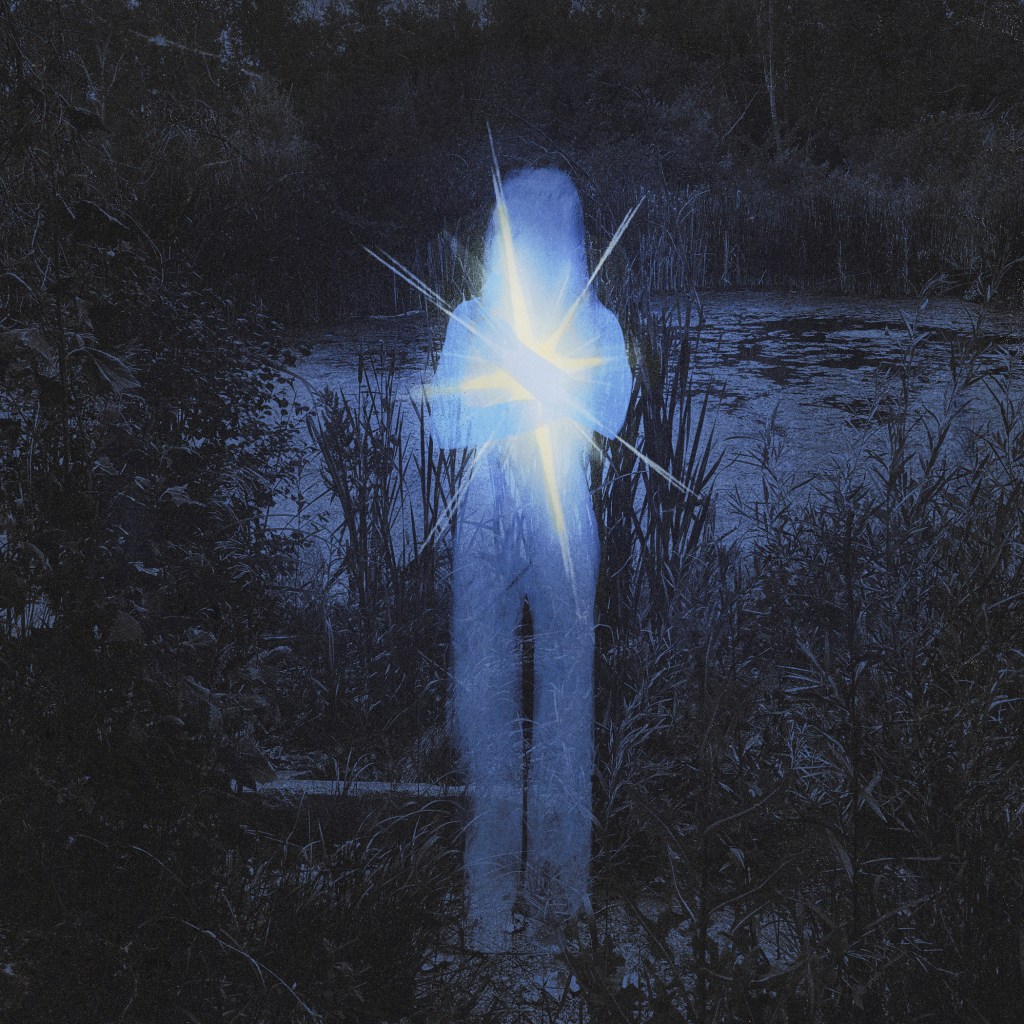
AM: We’ve talked quite a bit about the sonic and lyrical components of ratstallion, but I’d love to know what inspired the visual aesthetic that has been accompanying your releases that you use across social media and the “jacket covers” for your double-singles.
P: Well, I’m a marketing person and a designer, and I think that the visuals will tell as much a story as the music does, and I really wanted to create a world [for our music]. It also gives us kind of a sense of anonymity, especially since none of us, let’s be so real, are gonna be like the “did I just write the song of the summer?” people you see on TikTok or whatever. I feel like me creating our visuals is so much more palatable, and cheaper, honestly. I also hadn’t seen anyone else do a fully cohesive visual story as a band on our tiny level, like from the genesis. You can see something and know that it belongs to us, and it’s just vague enough and real enough where people can see themselves in both the art and the music. We want people to connect to something that is very much it’s own entity.
M: We want people to feel like they can be a part of the flow and the movement and the experience of it, just as much as we are.

AM: Have you given the entity that you’ve created as this figurehead a name or a title or anything yet?
P: I guess that’s just ratstallion. Like it’s pretty – that’s stallion – but it’s also kind of grotesque in a way. We were recently described in an article as “kind of disturbing”, and we think that’s so funny. But it’s also very much in the spirit of how we’re going for something a bit ethereal and pretty but also slightly unsettling. We try and balance the etherealness, at least vocally, with like, black metal elements and breakdowns.
AM: Speaking of the inclusion of elements of black metal, what do you feel are the most important elements for you to include in your music? Not necessarily just guitar or bass, but like a motif or riff pattern, or anything like that?
P: I mean, Lenny could tell you that better than anyone. Like, we’re writing the same fucking riff, just in different triads.
L: I mean, yeah, basically. I don’t know how music nerdy we’re trying to get here.
AM: Be as music nerdy as you want! A big part of what ARDENTLY is to go in depth about anything and everything to do with a project and make it a little more digestible for someone who maybe doesn’t have a technical background or classical training, and to make your art more accessible for someone who’s maybe trying to get into your particular style of music. So, nerd out all you want!
L: Drop-D 9th chords.
P: Yeah, we’ve never really deviated from Drop-D. I like, don’t tune [differently] anymore.
L: I mean, you two might not, but I don’t drop tune a bass, because that would be sacrilegious.
M: I often find that when Lenny and I are writing the layers underneath the more tonic chord progressions that drive the melody, I find that it focuses on the minor second, which is a really tense part of the major scale. Usually, this type of music is really minor sixth-heavy, correct me if I’m wrong, but I think the minor second is fun because it’s like, I guess a little jazzier? It kind of creates that disturbing, kind of dark, texture, you know?
P: Lenny and I definitely have jazz backgrounds, and that makes a lot of sense. I hadn’t thought about it that way before.
M: Yeah, it’s in there. That like, little [vocalized riff]…that’s the Dorian Lift, and then the drop, that melody, is often recurrent at some point or another.
AM: That’s really interesting. Like, it’s not something that you would think to infuse, because for you it’s not a conscious thought that you’re fusing these elements, necessarily, since it’s something that’s so ingrained in you. That’s really cool.
P: I also really love the synth texture. I’ll usually just go in and add most of the synths to anything to just like, fix it. Just some, like, egregious pad. In some of the early stuff, surf rock elements might come out, but maybe in a way that only we recognize.
AM: I think something else that’s really interesting about your music is that there’s so many different things that people can listen to and they can identify some other adjacent genre, and upon each listen you can kind of pick up something new and different. So, maybe there’s a thought y’all have that others won’t hear [different genre elements], but I think the more people are given a chance to sit with your work, the things that you think are a little hidden, not the most out-there, neon sign type of thing will come out and be made a little more obvious.
P: That’s true, and I think that we’re starting to see that a little bit. This project has also grown way faster than any other project that we’ve been in, and for us to only have 4 singles out in the past few months, we’re going pretty good as far as small bands go. And now we’re planning to go out on the road, too.
AM: That’s really exciting! I am really stoked for y’all. And speaking of those few releases in just a few short months, I’d love to touch on your most recent release: “Pit/Eye”. What inspired this release?
P: I think, collectively, existential dread. In a way, they’re both about not being present, in a sense, which is a huge, underscoring theme between the two. I mean, technically, “Pit” is a poem about fossils, but the sentiment of it is that you’re really not realizing what something is, or even valuing what something is, when you’re first in it, but it’s value grows when you’re out of it. It’s almost a euphemism for a relationship, but the beauty in it is that it’s over, in a sense, and looking back, would you have known that all you were romanticizing would eventually be known for it being an end, like a fossil. There’s a lot of layers to it. And “Eye” is very much about having a dissociative crisis, and I wrote it while on a mental health walk. I was standing over this bridge over gross water, and had the intrusive thought of “just throw yourself in. do it”, and that’s where that second verse, that line “mouthful of silt / I need a shock to the system” comes from. It was very much about actual, gross water, but there’s another undercurrent of it being about being emotionally present and being able to feel something as a true, organic feeling rather than the thought about the feeling much later. And that’s where the chorus line “All under the watchful eye of a future me” like, I will have a way to feel about this in the future. We even initially had a sound sample of Mr. Rodgers in it originally, and there’s a snippet of it in the teaser or one of the ads or in the visualizer now. He was like “we can be present to the moment with each other; that’s what’s ultimately important” and I really feel like that’s the sentiment of the song.
AM: Of all your releases, “Eye” has been my favorite, and I’ve had it on repeat these last few days. But I really love the metaphor for “Pit”. I really think there’s a gross underuse of more, I suppose, morbid metaphors, but the fossils metaphor is such an amazing way to frame everything. And speaking of releases and lyrics and all of that, do y’all have a favorite current release, and do you have a favorite lyric or riff from it?
M: “Eye”, for me.
P: “Eye”, and I don’t wanna speak for Lenny, but like, collectively, is kind of the favorite. We had kind of high expectations for it, which are kind of on their way to be met, which is really fun. It’s my favorite one that’s out now, but there’s moments in other ones [that I really like]. Like the opening line of “Spire”, that’s like a guided meditation on double playback speed. I was just really attached to that line and I still really like it, and I don’t know how I would have said it any better.
M: Lenny and I, as therapists, really connect with it as well.
L: Pretty relevant with our work.
M: Lenny, what’s your favorite?
L: I probably agree with y’all on “Eye”. I really like the breakdown section of it a lot, which is ironic, as I don’t think I really had anything to do with that section. I like the juxtaposition of how the next heaviest thing we have is the bridge breakdown in “Eye” and then just a lot of noise going on and, I dunno, I just think it’s…cool.
P: I’d also like to shout out that Lenny played both sitar and harmonium on “Pit” and we’re never gonna get him to do it again [laughs].
L: I mean, it did well enough because people were like “oh, what’s this cool texture” but, I need to burn my sitar.
P: There’s a lot going on in the intro for “Pit”. We had a lot of fun doing this like, hard vibe-swap. There’s a lot going on for there to not really be a lot going on. There’s like six different instruments in the beginning.
AM: I’m gonna have to try and pick everything out on my next re-listen, going forward. Speaking of going forward, where do you hope your music takes you? Is there somewhere you want to see it featured? Is there somewhere you want it to go, physically or sonically?
P: The focus right now is “tour”, and it’s starting to be a little more realistsic, especially in being like “how are we gonna do this with our corporate jobs”. For me, my like “lofty” goal has always been to hit a Europe tour. We were actually told by somebody at one point that [we] would only be popular in Europe [laughs], but he is just a joker. But goal-wise, I think it’s just having our music find its audience and having people authentically connect with it.
M: For me, sonically, we’re moving in heavier directions, and I’m excited for that. I’m excited to explore thicker, heavier tones. As far as in the world, en vivo, I keep referencing the fear that I wasn’t gonna be able to do this but here I am, and I’m grateful for this every day. And I didn’t even consider the possibility that other people would be enjoying the music, too, so that’s really lovely. More of that sounds great to me.
L: I’m super excited for the new stuff we have lined up to come out. There’s heavier pieces, faster pieces. I had not a lot of expectations…not in a “oh, this isn’t gonna go anywhere” type of way, but in a “oh god, I haven’t played music in over 10 years” type of way. So I was like, “yeah, let’s do it” and now I get to do it every week. And the fact that people like our music and that Phoebe hasn’t killed me yet is a good feeling.
AM: What do you hope people take away from your music? If there was one thing you wanted them to take away with them after listening, what would it be?
P: I feel like, for me, and maybe this is just because I’m considering where I’m writing from, is a comfort in self-ness, like a comfort in isolation. Like, yeah, everything is a bit existential and trapped in the little ball of who you are, but you’re fully equipped to deal with that and not in a “it’s you against the world” sort of way, but in a beautiful and transcending way.
M: “Connecting outside yourself can help you get back in touch with yourself again” is what I really hear out of that. And I feel pretty similar in what I hope people can get out of [our music].
L: I think I’d echo the sense of existentialism and that we’re all in it together. I think, especially right now, it can feel isolating but the idea of “someone else knows how that feels” is kind of a source of hope.
AM: My last question for all of you is: “what do we have to look forward to from ratstallion”? Are there any little hints you could drop about what we could be expecting?
P: So we are releasing an EP in the fall that is going to complete the set of what we’ve been releasing. Exact track number…maybe more than we initially planned, maybe exactly what we initially planned. It’s called Sisyphus Happy, and it’s coming out in the fall. We’re really big into the big “spring and drop” sort of thing. I’m not gonna ask anyone to like, presave anything, except for Lenny’s discord pals, because I love to just be like “it’s out”. Like, the last time I presaved something and remembered it was coming was maybe never [laughs]. And I’m not saying that nobody should do that, but I’m just saying that personally, it drives me a bit crazy. I like it just being “it’s here and it is what it is”. [The EP] is gonna be weird, in some ways. We’re getting progressively stranger in our experimentation with just like, different, juxtaposed musical themes – heavier, for sure. I’m just really excited for the new stuff coming out.
M: I think, thematically, that to a lot of folks, and especially to us, it feels like a closure of the themes we’ve been working with. There’s a lot of directionality that will become more clear for people, especially for people who are really into the lyrics and get really connected with them. They’ll hear something and be like “oh this is where this was headed”.
P: To Max’s point, it’s really wrapping up the themes and the era of those songs, sort of like a little package. I’m really excited for how people are going to react.
L: I feel like I’m just echoing Phoebe. The next few things coming out are some of the favorites [of ours] and I think they’re all just a sort of culmination, sonically and writing-wise, in our process.
P: We’re really stoked about it.
You can find ratstallion wherever you stream your music, and on Bandcamp, Instagram, and YouTube.
 ARDENTLY
Leave a comment