
Through reading what I’ve written, you might be under the impression that I’m in possession of a vivid imagination. It’s true that my mind comes with up things I never would’ve thought of without it, but I like to believe that none of my thoughts (or anyone else’s) exist in a vacuum. This is to say that whenever I imagine myself as the main character in a post-apocalyptic novel, like The Road, it isn’t just the product of my crazy mind, but also the crazy music I listen to.
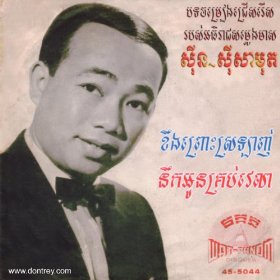
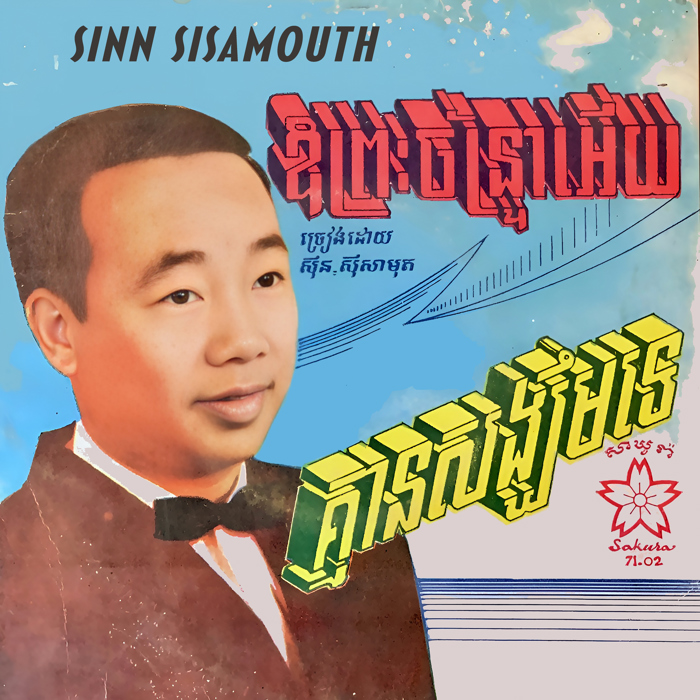
It really is a surreal feeling listening to music that sounds like it comes out of an archaic radio signal, thought to be long taken off the air, yet here it is – the air waves vibrating into the atmosphere and seeping into the holes in the side of my head. It’s the kind of ambience that I get from listening to older country recordings. After the dust settles and all is lost, “Cold, Cold Heart” by Hank Williams will still play as I walk down the cracked remnants of I-15, only for the credit to roll in my feature film debut. To make sure we get the perfect lo-fi soundtrack for my star-making performance I’ll harass the director until he either gets a restraining order on me or includes a few songs from the 2012 compilation: Wat Phnom: Best of Sinn Sisamouth Vol. 1.
This is another situation similar to Muslims & Christians, where the music was recorded much earlier, but only had the opportunity to be released in the 2010’s with the rise of streaming and digital downloads. They’re not entirely analogous in this regard, as Sisamouth was a life-long recording artist who managed to put out many releases in his day; his catalog is much more extensive than Keila’s ever was. Muslims & Christians was also a definite work that had a point it was trying to get across – those songs were written to be on that album, so it makes much more sense that the record wasn’t labelled as a compilation. By contrast, these songs could just as easily be interchanged with any other unreleased Sisamouth track that may be floating into the ether and pouring into our city streets with a miasma as thick as pea soup.

That isn’t to say that these individual tracks aren’t worth their weight in 2017 Nissan Rouges, on the contrary I feel like all of these tracks shine even brighter than the Rogue’s high-beams in the deep Ozark wilderness at night, all by themselves. Each track is a melancholic burst of lo-fi early Rock N’ Roll as well as Rhythm and Blues-inspired psychedelic balladry. Songs like “Tnagi Na, Tnagi Na?” illustrate this influence so gracefully with its electronic organ laying a nice, wavy, and fluid foundation for the syncopated, almost percussive guitar arpeggios as Sisamouth croons his heart out for everyone to hear. Meanwhile, tracks like “Lus Lung Krown Toray” seem to take a bit more influence from the more country-adjacent artists of early rock music, with a prominent bass line, faint background vocals and forlorn demeanor. There’s also prominent violin playing all over the song that plays second fiddle to Sisamouth, but it’s hard to say if that’s more country-inspired rock influence creeping in again or that it’s more of an expression of Khmer music traditions.
The record makes it hard to discern where one influence ends and another begins, which makes a for a fascinating predicament for the Midwest cowgirl who is currently racking her head, trying to put that distinction of influence to pen and paper. It really is an interesting needle that Sisamouth has thread when recording these songs; the structure and compositional elements obviously take from early rock and rhythm and blues, but it lacks that explosive energy that make up iconic tracks of the genre like “Great Balls of Fire” by Jerry Lee Lewis or “Tutti Frutti” by Little Richard. Instead, its slower tempo reminds me of some of the blues that someone like John Lee Hooker would’ve put to tape. Many of Hooker’s songs like “Country Boy” and “Decoration Day” are reminiscent of the lethargic direction so prominent in this compilation. Sisamouth’s crooning vibrato also reminds me a lot of the early vocal pop pioneered by the likes of The Ink Spots. However, none of these influences can account for the psychedelic sonic palette the songs are absolutely drenched in.
Pointing out specific songs is almost pointless, as every track tends to achieve a certain level of reverb-soaked, hypnotic trance that lulls the listener into another world. As much as the record’s atmosphere can make for a mesmerizing experience, it can just as easily feel tiresome near the end after it’s trance like quality begins to wear off. Many of the songs all start to blend together and become indiscernible from one another. Every lo-fi recording slowly starts to disintegrate into a homogeneous blend of woeful musings, obfuscated with the sound of crackles and skips as you hear the record play from the next room over. It’s really about the only criticism I could levee at the record, which might not even be entirely fair to say. Compilations by their vary nature are just a collection of recording put together in a neat little bow, in this case without artist’s involvement. With that understanding in the back of our collective skulls, It’s understandable that prolonged listening may become tedious. Nonetheless it’s still how I felt after having listened to the record multiple times in preparation for this review.
There are tracks that do end up breaking the mold a bit, making the record better for it. “Soben Kerng Oun” is easily the most rock-orientated of the whole compilation with it’s striking lead guitar line and faster tempo. “Reatry Sngat” is also super notable for having what sounds like trumpet or trombone start the song with an earth-shattering horn line that continues through out the whole song. Sisamouth also puts to tape what may very well be his best vocal performance throughout the whole record. His quivering, heartbreaking tremolo displays so eloquently his impressive talents as a vocalist. “Eh Na Tov Tansor?” also makes some use of some brass horns for a solo. It also sounds like the track makes use of some higher-pitched woodwinds. The song’s beautiful orchestration make it a relative highlight for the compilation.
Another notable song is “Twey Ber Kyom Jea Neak Psong Preng” just for being most influenced by early rock-n-roll. It’s the most upbeat song on the whole record – it has some blues guitar lines and a strong melodic chorus. It reminds me a bit of something that Buddy Holly might’ve recorded. Meanwhile, more of that early country influence comes back in spades with “Ongrung Muy Pi Neak”. As a fan of early country, I appreciate the song’s abject and desolate attitude. Both the twangy acoustic and shimmering reverb of the electric guitar add so much to the song’s atmosphere that with the fiddle playing feels very reminiscent with many fantastic early country recordings. Actually, the record has quite a few violin parts that can break up the monotony of record’s occasionally-overbearing wall of melancholic reverb. It’s difficult to parse if the violin playing is really the result of any country influence, songs like “Konlong Pnher Bran” and “Kmun Pnher Sombok” sound like they could just as easily be a reflection of traditional Khmer melodies through the medium of strings.
Unfortunately for Sisamouth, he disappeared in 1976 after Khmer Rouge forces captured the capital city of Phnom Penh. He is believed to be a victim of the Cambodian Genocide carried about by Pol Pot and his regime, due to his disappearance being not long after the forceful evacuation of all residents in Phnom Penh. However, his official cause of death is undetermined and therefore leaves nothing but speculation as to his status or whereabouts. For as tragic as his loss is, he was a deeply important figure in the musical identity of a nation struggling to find its footing in a new modern world, post-French colonization. He doesn’t just have to be remembered as the victim of tragic genocide – he was the stitching that helped to keep the patchwork of Cambodia together while his country was going through some of its most tumultuous times. He was a voice for people during the civil war, and for a brief moment in time he might become a voice for you as well, whenever you decide you need someone to accompany you in your loneliest of hours.
If you would like to listen to Wat Phnom: Best of Sinn Sisamouth Vol. 1, you can stream the compilation on Spotify, Apple Music, YouTube Music and Amazon Music. If you would like to support the Cambodian Vintage Music Archive in their effort to both preserve old Cambodian recordings seized by the Khmer Rouge and to provide financial aid to the surviving family members of Cambodian musicians, you can either buy music from their website or donate to them. If you’re interested in the history of Cambodian music, both the book Away From Beloved Lover and the documentary Don’t Think I’ve Forgotten have been described to me as very informative, however as I have not had the opportunity to consume them I can’t attest to their quality myself.



 ARDENTLY
Leave a comment